


The Long Walk
- Joshua Xiang

- Oct 22, 2025
- 4 min read
By Joshua Xiang
"Don't skip your leg day."
In a desolate alternate history of the 1970s, a postwar America sets an annual contest for fifty kids, each representing their home state; their goal is to walk, slowly but steadily, never dropping below 3 miles per hour, down a long country highway. If they lose speed, they get a warning and ten seconds to regain their footing. Three warnings, and the garrison of soldiers following them with M16S shoots them dead.
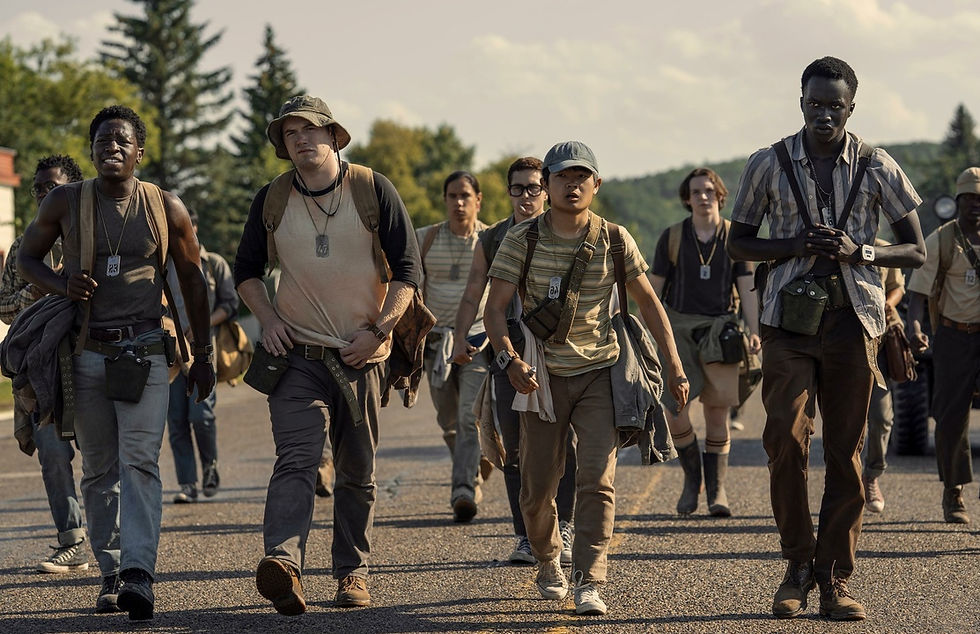
The methodical premise feels difficult to dramatize, but the director Lawrence, who directed after four “Hunger Games” films, clearly knows a thing or two about teens trapped in dystopian games for public consumption. Among many players, we mainly follow a few: the jokester Olson (Ben Wang) and the unstable antagonist Barkovitch (Charlie Plummer), as well as a couple of other characters, who all have distinct characteristics. The fascinating part is that the portrayal of each character doesn't feel repetitive, and all of them have an unexpected arc. The story, especially in JT Mollner’s script, focuses most acutely on the budding friendship between sensitive Ray Garraty (Cooper Hoffman) and the punchy, endlessly optimistic McVries (David Jonsson). In a game where it’s every man for himself, the two of them figure out ways to help each other, and occasionally their fellow contestants, stay alive just a little bit longer.
It’s no coincidence that King wrote this during the Vietnam War. There is a lot of parallelism in this work about the terror of the draft, where young men are sent off to die at the behest of military orders, while an aghast American public watches on their TVs.

What I like most is the film’s quiet, ongoing debate over what values a citizen should hold in a (dys)functional society. Through Ray and Peter’s conversations, we get two fully realized worldviews: how to live, what to live for, and what “winning” should mean. Because only one walker can survive, death is a given for most, and the first debate is about mindset at the outset: Peter believes in living in the moment; Ray fixes on the prize and the end result. The second debate asks what to do with the winner’s wish. Ray wants a carbine to kill the Major, the face of the Long Walk’s cruelty, though the film also suggests he’s a product of his time and system. Peter rejects vengeance; he wants to change the rules so two survivors can finish together, allowing friendship and bonding to coexist with competition.
A roadside encounter crystallizes their difference. When Ray and Peter pass three generations of women watching them, Ray sees a corrupted society that has subconsciously accepted the Walk—death as entertainment. He thinks the system must be torn down, its enablers confronted. Peter, an orphan who’s lived on the road, sees instead the love and warmth of family, the possibility of grace. Like his wish for two survivors, he believes people can be enlightened, not eradicated.
The result of this long hidden debate between the two friends, conclude at the end.
Although King has said he didn't explicitly intend it that way, The Long Walk novel is often seen as an allegorical critique of the Vietnam War and the senseless death and spectacle of state-sanctioned violence that accompanied the conflict.

"You write from your times, so certainly, that was in my mind. But I never thought about it consciously," King told Vanity Fair. "I was writing a kind of a brutal thing. It was hopeless, and just what you write when you’re 19 years old, man. You’re full of beans and you’re full of cynicism, and that’s the way it was."
Still, King's story ends on a suitably bleak note for that reading. After Peter McVries chooses to sit down and accept his death, and Stebbins (played in the movie by Garrett Wareing) collapses from exhaustion, Garraty is the only remaining walker. However, instead of celebrating his victory or even realizing he has won, Garraty continues on in pursuit of a dark figure beckoning to him in the distance, thinking the words, "There was still so far left to walk," before somehow finding the strength to run.
It's a darkly ambiguous conclusion that seems to suggest Garraty's psyche has been shattered by the experience, and the walk will never result in any true victory. The movie, on the other hand, offers a more definitive and, to a certain degree, hopeful ending that highlights the power of human connection in the face of brutality.
Once Ray Garraty and Peter McVries are the only walkers who remain, McVries attempts to kneel down and sacrifice himself to allow Garraty to win. However, Garraty runs back and convinces his friend to walk a little further with him before taking advantage of McVries' distracted state to do what McVries had planned to do for him. After McVries wins, he uses his one wish to request a gun and, despite knowing it's a death sentence, kills the Major just like Garraty had told him he originally planned to do. He then continues walking down the street.
"It’s about acts of kindness and how they affect you,” David Jonsson told Vanity Fair of the movie's message. “You get that beautiful act of surrender, of putting you before me. That’s part of McVries’s journey with Garrity. How do you pass on the kindness that was given to you?"
The film resolves their argument by refusing a binary. Ray’s punitive radicalism and Peter’s reformist compassion are revealed as mutually necessary. Justice without empathy is terror; empathy without consequence is denial. The ending implies that a moral society demands both.


Comments